What ridge-and-hollow terrain does to this problem
A leaning tree in Pickens County earns a more complicated read than the same tree on flat ground. The county sits where the SC Piedmont rises toward the Blue Ridge escarpment, and that transition — ridges, hollows, and cut-and-fill residential lots through communities like Six Mile, Liberty, and Dacusville — means a lean may reflect slope-normal growth, gradual root failure, or sudden post-storm shift. Those three causes call for three different responses, and mixing them up is costly either way: removing a stable slope-grown pine wastes money; waiting on a root-failing oak above the back porch carries its own price.
Pines, white oaks, and tulip poplars are the dominant large-canopy trees on Pickens County residential lots. All three grow fast enough to reach hazardous size within a generation of a home being built, and all three anchor differently. Pines run shallow lateral roots easily disrupted by grading; oaks rely on a taproot that can compromise with age; tulip poplars develop wide-spreading root plates sensitive to soil compaction from construction work. When a builder cuts into a hillside to level a yard, the uphill soil anchoring any of these systems is gone, and a tree that held for twenty years can cross a threshold quietly after a wet spring.
Signs that separate a prompt call from a watchful wait
Not every lean is a hazard. The indicators that move a tree from watchlist to call-today are specific: soil heaving or a cracked arc of ground on the tension side of the base (the side opposite the lean) means the root plate has begun to lift. Bark splitting, soft wood, or mushroom growth at the root crown points to decay where the tree carries its structural load. Any lean that appeared or worsened after a rain or wind event means something shifted, and the tree warrants assessment within days, not at the next convenient scheduling window.
Slower signals carry less urgency but are not irrelevant. A mild lean present for many seasons with no ground disturbance and clean bark may warrant a six-month monitoring interval rather than emergency scheduling. The Clemson Cooperative Extension Home & Garden Information Center notes that internal decay cannot be assessed from the outside — a tree with a compromised core can hold its lean for years before failing without additional warning. When the signs are mixed — a steady lean, some bark damage, no ground movement — a qualified crew with a probe or resistance drill can answer what a visual check alone cannot.
Cost and scope for Upstate SC conditions
Three paths exist for a leaning tree: removal, structural cabling, or monitored waiting. The right one depends on root health, lean direction, and what is in the fall zone. For removal, typical Upstate SC ranges by situation:
| Situation | Typical range |
|---|---|
| Small tree under 30 ft, open access | $300 – $600 |
| Medium tree 30–60 ft, near structure | $700 – $1,300 |
| Large tree over 60 ft, complex rigging required | $1,300 – $2,000 |
| Cabling and hardware (tree retained, support added) | $400 – $900 |
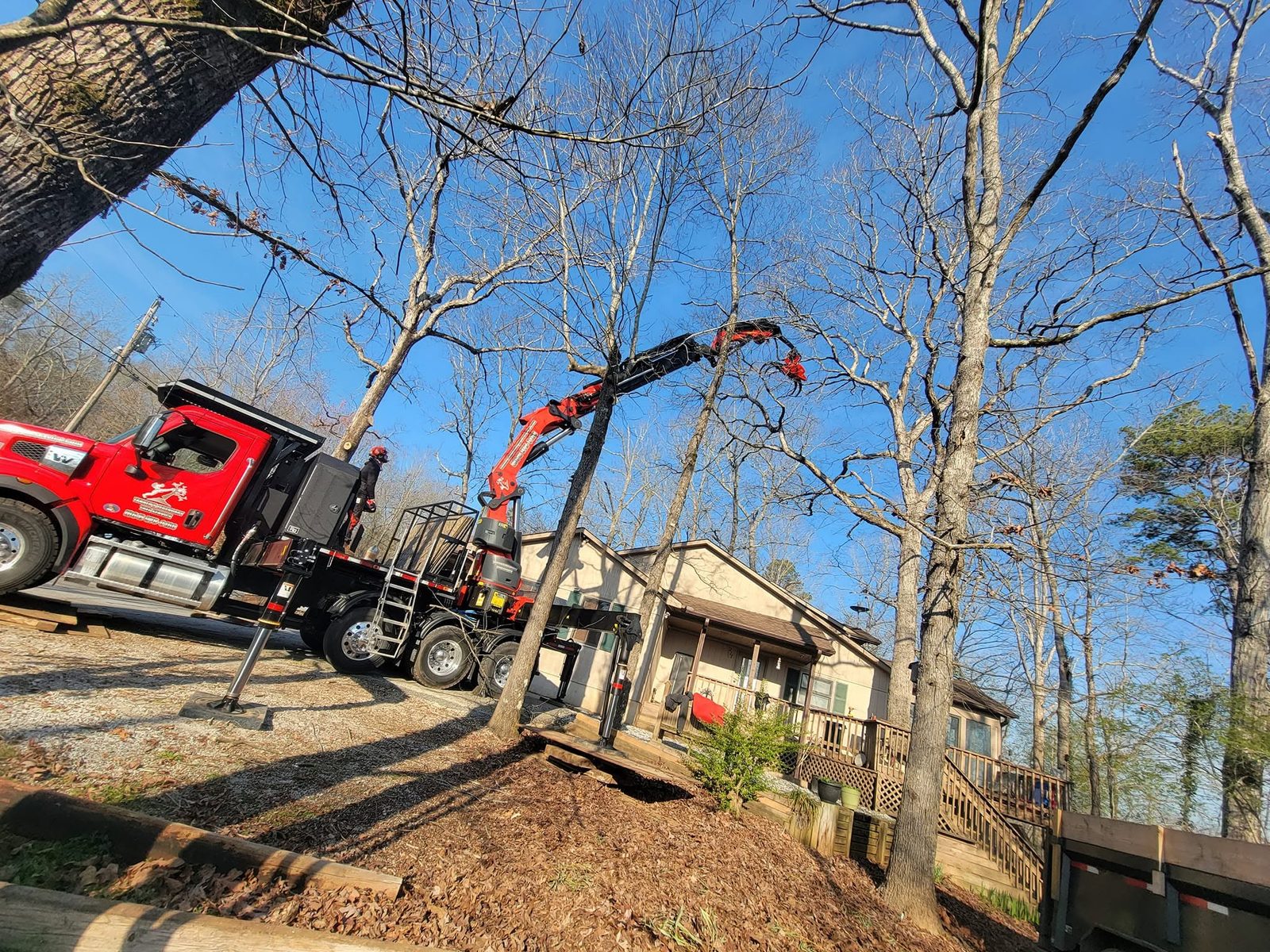
Slope lots in Pickens County often push jobs toward the upper end of their size class: a large tree on a cut hillside above a driveway may need crane or block-and-tackle rigging that adds to the base range. See the full tree removal cost breakdown for how access conditions, stump work, and debris haul affect the final number. Every job gets a free on-site estimate — the table is a planning guide, not a quote.
When a power line is in the picture
A leaning tree whose crown sits near overhead distribution lines is a different category of work than a standard removal. Pickens County's older county roads carry above-ground lines, and properties near the Lake Keowee corridor often have utility infrastructure running close to canopy that grew past its original right-of-way. When the direction of lean puts the crown within reach of any overhead conductor, that is a power-line tree job — it requires utility notification, different rigging methods, and sometimes utility company coordination before the first cut is made.
South Carolina contractor licensing requirements, administered through the SC LLR Contractor Licensing Board, apply to tree work above certain thresholds involving structural or electrical risk. Before any crew operates near your house or a line, ask for their license and proof of liability coverage. A crew that cannot produce documentation quickly is not the right crew for a hazard job, regardless of how competitive the estimate looks.
Storm history and what it means for your assessment window
Pickens County carries a significant federal disaster record — 23 declared events spanning 2005-2026 — concentrated in wind, storm, and flooding events. The same storms that earn those declarations saturate the clay-heavy soils of the Upstate SC foothills, and saturated clay lowers the root-plate threshold. A tree that held its lean through a dry summer may shift in the first sustained wet stretch of fall. That risk window matters most for trees already on a monitoring list: a watchful-wait candidate becomes a call-today tree faster after a significant storm than the same tree would on flat, sandy ground.
The SC Forestry Commission tracks forest health conditions statewide, including drought stress and southern pine beetle pressure that weakens root structure before storms deliver the final load. For a leaning tree also showing crown dieback, yellowing needles, or unusual out-of-season leaf drop, that combination justifies faster scheduling than the lean alone would. When the assessment points toward removal, the tree removal process page covers what a qualified crew does from first site visit through final debris haul and stump work.