Foothills trees fall differently
Pickens County's foothills grow trees that most of Upstate South Carolina's newer suburbs never see at full size. The older neighborhoods of Easley carry white oaks and tulip poplars that have been climbing for decades with no competition. The wooded lots along Highway 11 and around Lake Keowee hold stands of loblolly pine that dwarf anything on a coastal plain lot. When an Upstate storm pushes one of those trees into a house, the physics are different from a flatland windfall.
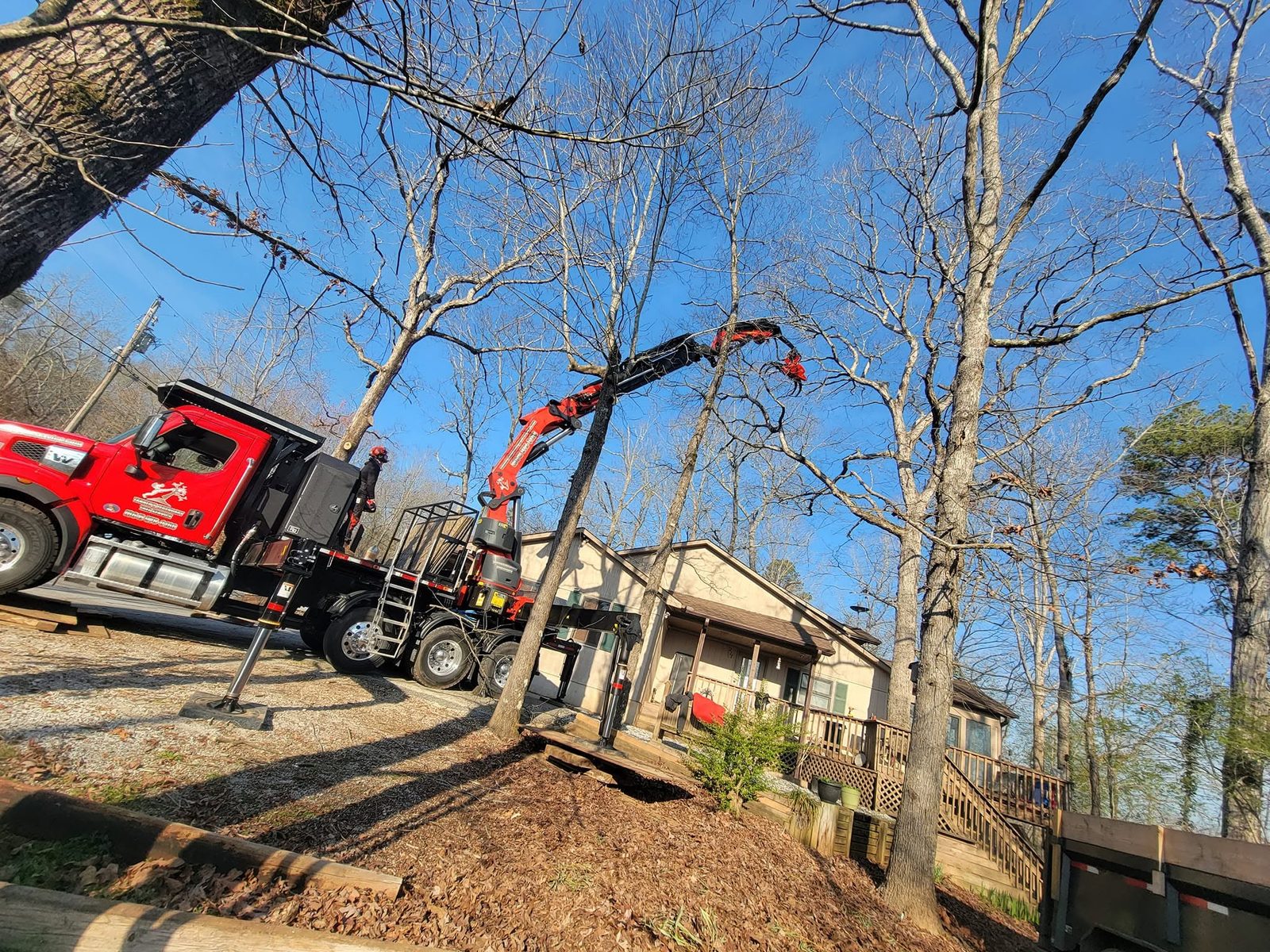
The trunk is longer. The crown is heavier. The contact angle with the roof is rarely clean. After impact, the tree may still be under tension — loaded against the structure at a point that will release unpredictably if someone cuts the wrong section first. That is the gap between standard removal and storm-damage tree work. A crew that knows storm work assesses the loading direction before touching a saw; one that does not can drop more weight onto the roof than was already there. That difference is the first thing worth understanding when a tree has come down on your house in Pickens County.
The right sequence when it happens
After impact, two clocks start running: the structural clock and the insurance clock. For the structural clock, the question is whether the building is safe to stay in. A damaged roof is an unknown until someone qualified assesses it; if the opening is exposed to weather, a tarp on the breach matters immediately because water damage compounds faster than most adjusters can schedule a visit.
For the insurance clock: photos before anything moves. Document the contact points, the root ball, and where the crown is relative to the roof line. Pickens County has a real storm record — 23 federal disaster declarations across 2005-2026 — and the NOAA National Weather Service archives county-level storm events. If a severe weather warning was active when the tree fell, that record becomes part of your claim documentation and can help establish that the fall was storm-driven rather than from pre-existing decline.
The emergency tree call and the insurance call can run in parallel. Most homeowners policies allow emergency mitigation before an adjuster arrives — you do not need to wait with an open roof — but document what you do and why before the crew starts work. See does homeowners insurance cover tree removal for the full claim picture.
What the work costs when a tree hits a structure
Emergency and storm tree removal runs above standard rates because the job is hazard-rated by default: the crew works around an occupied structure, often under time pressure, with a loaded tree that may require rigging rather than a straight cut. The variables that move the price are tree size, degree of structural contact, terrain access, and time of call. These are typical Upstate SC ranges; Tree Wisemen prices every job after a free estimate within 50 miles of Easley.
| Scenario | Typical Range |
|---|---|
| Small tree (under 30 ft), partial roof contact | $500–$900 |
| Medium tree (30–60 ft), significant roof contact | $900–$1,800 |
| Large tree (60+ ft), major structural contact | $1,800–$3,000 |
| After-hours or urgent response | Toward the upper end of the applicable range |
| Steep terrain or utility proximity | Toward the upper end of the applicable range |
These are per-tree figures. If multiple trees came down in the same storm — a common outcome after a fast-moving Upstate line — the total scales by tree count, though mobilization and haul-away may partially overlap. The emergency tree removal cost page covers multi-tree scenarios and what to expect in the itemized quote.
What your homeowners policy covers and what it does not
Whether your insurer pays to remove a tree that fell on your house depends on what caused the fall and what it landed on. A storm-driven tree that damages a covered structure is typically covered under the dwelling section of a standard homeowners policy. A tree that fell without hitting a covered structure is usually not, even if the storm brought it down.
The complication that catches homeowners off guard: if the tree was visibly dead or declining before it fell, some carriers treat the loss as a maintenance issue rather than a storm event. That distinction hinges on the root ball and the break point. A tree that uprooted in wind looks different from one that snapped at a rotted section — and an adjuster will look at both. Photograph the root zone and the break before the crew moves anything.
Also check whether your policy includes a separate debris removal limit, which some policies cap independently of the dwelling coverage. That line item matters when the tree is large and the extraction is complex. The emergency tree service page covers what documentation the crew can provide to support your claim.
Choosing a crew for storm-damage work
Storm work on an occupied structure is not standard removal. The crew needs to understand rigging under load, roof contact points, and how to sequence cuts so each section lifts clear rather than adding downward weight. Ask directly: how do you assess tension in a loaded tree? The quality of that answer tells you more than any credential on the truck.
In South Carolina, work that crosses into structural repair alongside tree extraction — tarping, temporary shoring, roof patching — may require a licensed general contractor under the SC LLR Contractor Licensing Board. If the crew will do any structural work beyond cutting and hauling the tree itself, verify their license scope before work starts.
For the arboricultural side, the SC Forestry Commission provides resources on tree risk assessment and worker safety standards that professional crews train to. Pickens County's foothills terrain adds a practical consideration: steep access and utility proximity on some lots require additional rigging or crane positioning that a flat-lot job does not. Ask what equipment is coming before the crew arrives so the quote reflects the full scope and the invoice matches it.