Pickens County issues no tree permit — here is what does apply
Pickens County has no county-wide tree removal permit requirement. For a property in unincorporated Pickens County outside any HOA, you can legally remove a tree on your own land without filing anything with the county. That answer satisfies about half of callers. The rest own property inside a municipality, inside a planned community with CC&Rs, or along a recorded utility easement — and those situations carry entirely different rules, enforced with real consequences.
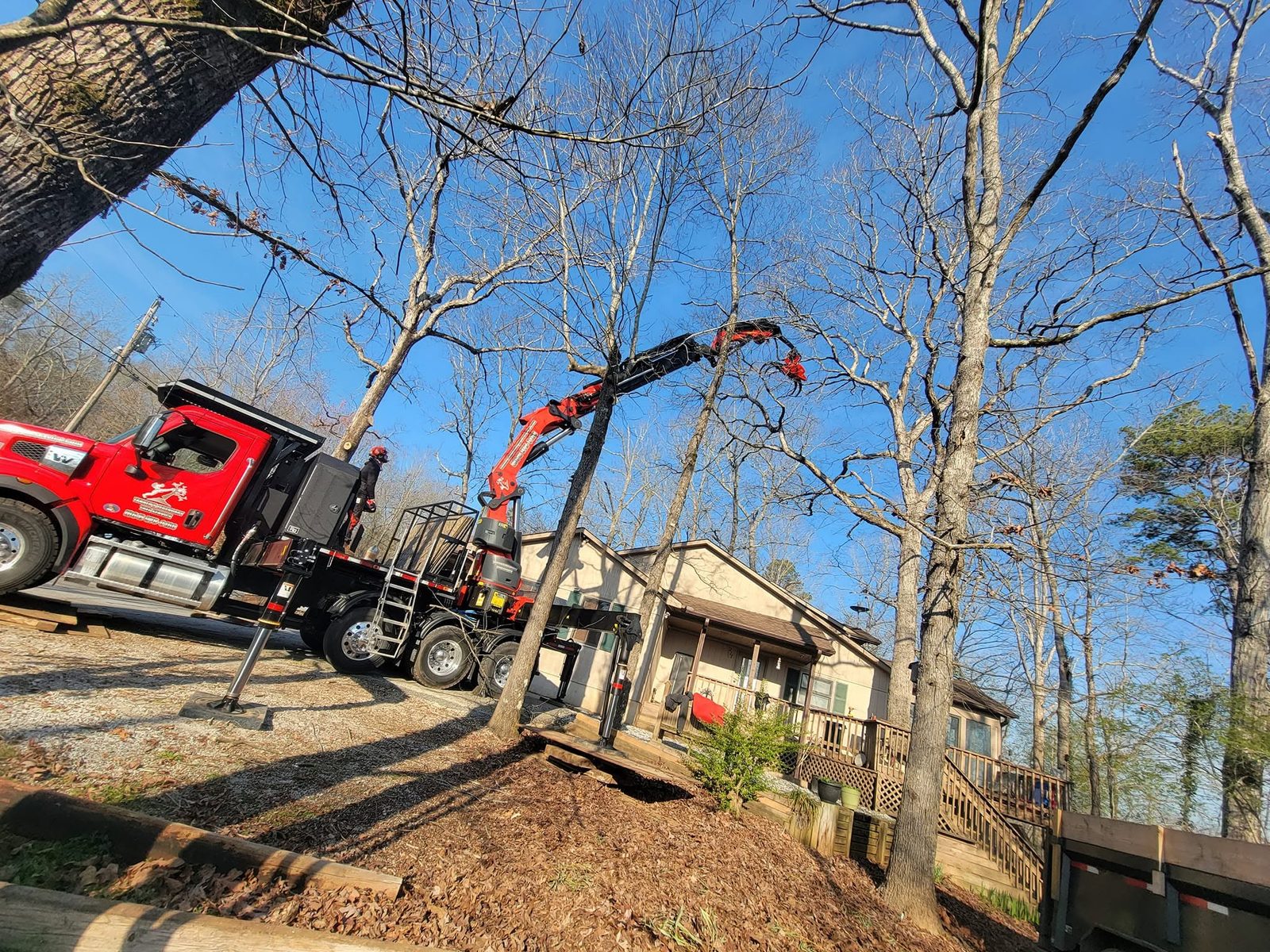
The terrain sharpens the stakes. Pickens County sits in the Blue Ridge foothills, where lots climb steeply off ridgelines, large white oaks and tulip poplars grow 80 to 100 feet with root systems that follow the slope, and a neighbor's roofline often sits directly below the fall zone. Tree removal in this part of Upstate South Carolina involves access constraints, elevation change, and crown proximity to structures in ways that simply don't appear on flat lots elsewhere. Knowing whether approval is needed before the crew arrives is part of the job — not an afterthought.
| Situation | Permit or Approval Required? |
|---|---|
| Unincorporated Pickens County, no HOA | No county permit required |
| Inside Easley, Clemson, Central, Liberty, or Pickens city limits | Contact that municipality's planning or building department |
| HOA-governed community (CC&Rs in force) | HOA architectural or landscaping committee approval typically required |
| Tree within a recorded utility easement | Coordinate with the utility company before cutting |
| Commercial land disturbance above threshold acreage | Land disturbance permit from county or SCDHEC may apply |
| Specimen or heritage tree under a municipal ordinance | Municipal permit required |
What municipalities in Pickens County actually require
Easley, Clemson, Central, Liberty, and the town of Pickens each administer their own building and planning codes independent of the county. Some have tree protection provisions tied to development review; others do not have a standalone tree ordinance. Clemson, as a university town with a dense campus-adjacent residential market, has historically been active on landscaping and canopy issues within its development review process. Easley, the county's largest city, has its own code enforcement structure that homeowners should verify directly before any significant removal.
If your address falls inside any of those city or town limits, the right first call is to that municipality's planning or building department — not the county. Staff can typically answer in a single call whether a permit is required, what documentation they need, and whether a certified arborist statement is part of the process for a specimen-sized removal. The SC LLR Building Codes Council oversees the statewide building code framework, but tree removal on private residential property outside a formal development context generally falls under local municipal authority rather than state building code jurisdiction.
One category that generates confusion: trees on or immediately adjacent to a right-of-way. Those trees belong to the governing road authority, not the adjacent property owner. Removal requires a separate approval regardless of where your property line falls, and cutting a right-of-way tree without authorization creates liability that no amount of after-the-fact paperwork will undo.
When your HOA is the gatekeeper, not any government office
The Clemson corridor and Easley's expanding suburban fringe are dense with planned communities whose CC&Rs govern tree removal independently of any government ordinance. Many of these documents require written approval from an architectural review committee before any tree above a certain trunk diameter — commonly six to eight inches measured at chest height — is touched. Some covenants prohibit removal of large specimen hardwoods outright. Others protect tree canopy buffers along rear property lines or along water features near Lake Keowee and the residential development that has followed the reservoir's shoreline.
HOA violations in these communities are not theoretical. Fines can accumulate on a per-day basis, the association can require replanting at your cost, and in some cases can place a lien on the property until the homeowner complies. Replacement requirements often specify matching species and minimum caliper — turning what felt like a simple removal into an expensive landscape restoration. A neighbor on the architectural review board can make the process contentious in ways no county permit office ever would.
The safe sequence: pull your CC&Rs before the crew arrives, submit the written approval request with photos and species information, get written sign-off, and keep a copy of both for your records. None of that touches the county or any government agency. It is entirely private contract — and it has teeth that often exceed anything a municipality would impose on a residential removal.
Who is licensed to do this work in South Carolina
South Carolina regulates contractor licensing through the SC LLR Contractor Licensing Board. Tree removal companies operating commercially in the state operate under that licensing framework. A reputable firm carries a valid SC contractor license, current general liability insurance, and workers' compensation coverage. On steep Upstate lots where felling direction is constrained and structures sit close to the drop zone, verifying those documents before anyone climbs is not optional — it is baseline due diligence for the homeowner as much as for the crew.
The SC Forestry Commission is the state authority on forestry-related rules, including open burn permits — required in most conditions when debris is burned on-site — and timber harvesting regulations. For a single residential removal, the Commission's timber rules generally don't apply. Clear more than a fraction of an acre and forestry best management practices and notification requirements become part of the picture.
When evaluating bids, ask for the license number and insurance certificates directly — not a summary from the salesperson. The LLR license lookup is public and takes about two minutes. For what the job should cost based on tree size, access difficulty, and proximity to the structure, see the tree removal cost guide for the Upstate region. Steep terrain, large hardwood canopy, and confined access routinely push costs higher here than broad regional averages suggest.
Storm damage, dead trees, and when waiting for approval isn't realistic
Pickens County sits in a storm corridor that has recorded 23 federal disaster declarations over 2005-2026. Ice loading from winter precipitation events, straight-line wind from severe thunderstorm systems, and occasional tornado outbreaks regularly damage or drop large hardwoods — white oaks, hickories, and tulip poplars whose root systems, shallow in the clay-heavy soils of the foothills, can tip whole when the ground saturates after heavy rain. Emergency removal of a downed or imminently hazardous tree typically moves outside standard permit timelines. Most municipalities allow emergency work to proceed with documentation submitted after the fact.
Whether a tree is dead or structurally failing changes both the urgency and sometimes the approval path. A tree with root crown decay or a trunk cavity that compromises load-bearing wood is an active liability; a standard municipal review window may not be a viable timeline when the tree hangs over a roof or a driveway. Photograph the condition thoroughly before work begins — that documentation matters if the removal is later questioned by an HOA, a neighbor, or a property insurer.
The Clemson Cooperative Extension Home & Garden Information Center publishes guidance on identifying structurally hazardous trees, including root failure indicators relevant to the steep, clay-heavy soils of the Blue Ridge foothills. When there is genuine uncertainty about a tree's condition before storm season, an arborist assessment is a fraction of the cost of a contested emergency removal.